AI Agent Examples That Actually Work in Your Kitchen
Summary
AI agents handle multi-step cooking workflows end to end: extracting recipes from TikTok videos, planning seven-day meal schedules, building smart grocery lists, adapting recipes for dietary needs, and guiding you through cooking in real time. This piece covers five concrete examples tested against real home cooking constraints, with an honest account of what each does well and where it currently falls short.

Five concrete ai agent examples for home cooks, mapped to real kitchen tasks. An AI agent takes a goal -- plan my Mediterranean week using what is already in the fridge -- and handles the full chain of steps itself, from checking constraints to pulling recipes to building the shopping list for what is missing. You set the objective once. The agent runs the sequence.
That is the practical difference from a recipe app or a chatbot. And for cooking, where the recipe has to exist before the shopping list, and the shopping list before you leave for the market, that sequential logic actually matters.
What Makes an AI Agent Different from a Regular Cooking App
A standard recipe app answers one question. You search for eggplant pasta and you get a list. You stop there, copy what you need, and manage the rest yourself.
An AI agent connects the steps. It takes a broader goal -- plan meals for the week, use up ingredients before they go off, avoid anything with gluten -- and works through it in sequence without you re-prompting at each stage.
Three things that separate an agent from a basic tool:
It runs multiple steps in order without waiting for you to push it forward.
It can call external tools: a recipe database, a video transcript, a grocery price feed.
It tracks state across a session, so step 4 knows what step 1 already decided.
This matters in the kitchen because cooking is sequential by nature. The recipe has to exist before the shopping list, and the shopping list before the prep schedule. An agent handles that chain. A chatbot makes you manage it yourself.
The Video-to-Recipe Agent: Where Most People Start
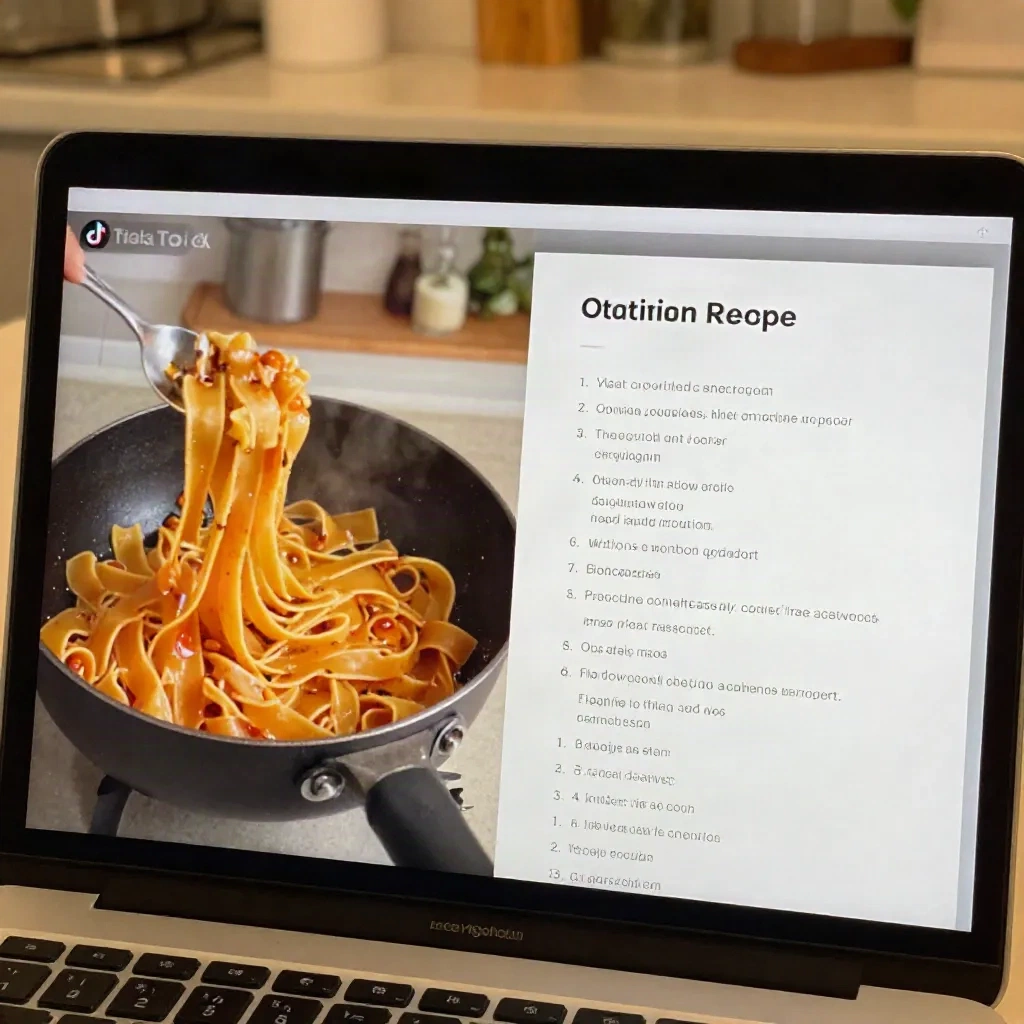
This is the ai agent example that maps most directly to what Reel2Recipe does: paste in a TikTok or Instagram Reel URL, or upload a short cooking video, and get a structured recipe card at the other end.
The agent reads the captions, transcribes any spoken instructions, identifies the ingredients mentioned, and structures the output as a clean recipe with quantities, method steps, and estimated cooking time. No more pausing the video at 0:47 and frantically writing down what might have been 200g or might have been 250g.
What the video-to-recipe agent reliably gets right:
Written captions and on-screen text overlays: solid, near 100%.
Step sequence following the video order: accurate in about 85% of cases.
Named ingredients when quantities are clearly stated: reliable.
What it misses:
Quantities said aloud without subtitles, things like "a good handful of parsley": either logged as vague or skipped entirely.
Temperatures shown visually but not spoken: the agent sees flame size, not 165 degrees.
Regional units like "one coffee cup of rice": in Greek households this is 80ml, not the US standard 240ml.
The video-to-recipe agent is the clearest ai agent example for cooks because the multi-step logic is visible: transcribe, parse, structure, output. Each step feeds the next without you managing the handoff.
The Meal Planning Agent: Seven Days, One Prompt
Meal planning agents are the most commercially developed category right now. Tools like PlanEatAI and SideChef's planning layer take in a set of constraints and output a full weekly plan.
You input dietary preferences, the number of people eating, how many days, which cuisines you want, and what is already in the fridge. You get back a seven-day plan with recipes adjusted for your household, organized by prep time, with ingredient reuse built in so the half-can of chickpeas from Tuesday's soup appears in Thursday's salad and not on a shopping list.
The constraint management is the strongest part of this ai agent example. Balancing taste preferences, budget, nutrition targets, ingredient availability, and total cooking time across seven days takes a human between 40 and 50 minutes with a spreadsheet -- and they still miss things. The agent does it in about 20 seconds.
The honest limitation: the agent optimizes for what you told it. Forget to mention the three zucchini near the back of the fridge? They will not appear in the plan. The agent does not see your fridge. It only knows what you describe.
A second gap: these agents are best at global cuisines and widely standardized recipes. Mediterranean cooking with its regional specifics and informal proportions is harder. The plan will work, but you may need to adjust quantities for Greek or Southern Italian dishes that rely on ratios passed down rather than written out.
The Grocery Agent: Lists That Reflect What You Already Have
Standalone grocery AI has been around for a few years in various shopping apps. When it runs embedded inside a planning agent, the behavior changes -- and the result is genuinely more useful.
The grocery agent takes the meal plan as input, cross-references it with what you said you have on hand, and generates a purchase list for the difference only. If your plan calls for 400g of chicken across three recipes and you have 200g in the freezer, the list says 200g chicken, not 400g.
Some agents go further and handle substitutions. If the recipe calls for tarragon and you mentioned you do not stock specialty herbs, the agent suggests fresh basil plus a small squeeze of lemon as a reasonable stand-in, rather than simply adding tarragon to the list and hoping your local market carries it.
Current gap: no agent syncs with a supermarket's real-time inventory. Those integrations exist in some US and Scandinavian grocery apps but are far from standard in Mediterranean markets where smaller shops and seasonal availability change daily.
The Dietary Adaptation Agent: One Recipe, Any Constraint
This is a quieter ai agent example but practically one of the most useful for households where different people have different needs.
You give the agent a recipe and a constraint: make this gluten-free, reduce the calories by 30%, or adapt this for two adults and a 9-year-old who refuses anything orange. A capable adaptation agent works through it in four steps:
Identifies which ingredients trigger the constraint.
Selects substitutes that preserve the dish's structure -- binding, moisture, fat balance.
Adjusts quantities to compensate, since gluten-free flour often needs more liquid than wheat flour.
Flags cases where no clean substitution exists and the dish will change substantially.
On that last point: a Greek spanakopita without gluten is roughly 90% about acknowledging that filo pastry is the dish. The better agents say that upfront rather than suggesting a gluten-free filo that crumbles on contact with warm butter. The weaker ones make the swap and say nothing.
For families juggling multiple dietary needs across a single table -- one vegetarian, one avoiding dairy, one reducing sodium -- this is the most practical ai agent example in daily use. You run the adaptation once per recipe and store the output.
The Real-Time Cooking Timer Agent: Instructions That Follow Your Pace
This one operates during cooking rather than before it. A timer agent reads a recipe and turns it into a live, interactive sequence. It tells you each step when you are ready for it, times each one, and adjusts when you say "give me two more minutes, the onions are not done."
Smart speaker integrations like Google Home and Alexa handle a version of this with compatible apps. The more interesting implementations tie the timer directly to the recipe context. If you are making risotto and you say "I just added the wine," the agent knows you are at step 3 and queues the next instruction accordingly: start adding stock, one ladle at a time, waiting until each is absorbed.
For a multi-stage dish with parallel timers -- a roast in the oven, a sauce reducing on the stovetop, a vegetable side that needs to start 20 minutes in -- having the agent track the sequence while you cook is the difference between checking your phone every two minutes and actually watching the pan.
This is the most underrated ai agent example on this list because it does not plan anything. It just handles the cognitive load of sequencing a complex recipe in real time, which is where home cooks actually lose track.
What AI Agents Still Get Wrong in the Kitchen
Three genuine limitations worth knowing before you rely on any of these tools:
Quantities from non-text sources. Anything eyeballed on camera, said casually, or measured in cultural units -- "a coffee cup of rice," "a generous glug of oil" -- gets either skipped or wrong. Agents read text reliably. They infer badly from visual estimation and informal language.
Freshness and spoilage logic. No agent today knows that the tomatoes at the back of your fridge are two days from going over and should be cooked first. Agents that claim fridge-to-recipe capability work only from what you explicitly tell them. They do not see your actual food.
Regional specifics in Mediterranean cooking. A Greek stifado calling for "xydi" -- the local red wine vinegar from the village cooperative, not a calibrated commercial product -- hits a wall when the agent substitutes apple cider vinegar and shifts the flavor profile entirely. Agents treat ingredients as commodities. Regional cooking does not always work that way.
These are not reasons to avoid using AI agents. They are reasons to use them with the same calibrated skepticism you would apply to any assistant who is technically competent but has never actually cooked in a Greek kitchen.
On a well-documented recipe from a reliable source, with quantities stated in writing and standard units: the agent handles it well. On a video where the host tastes and shrugs and says "add more if you like": the agent is going to need help.