What Is an Objective Summary? How AI Uses It for Recipes
Summary
An objective summary is a concise, neutral account of a source's main points, no opinions, no editorializing. When an AI tool extracts a recipe from a TikTok or YouTube cooking video, it is doing exactly that: producing an objective summary of the video's instructions. This article explains what makes a summary truly objective, where AI tools get it right, and where they still miss the mark.

An objective summary is a neutral, factual account of what a source says, stripped of personal opinion. When you paste a cooking video into an AI recipe tool, the output is meant to be exactly that: the steps, the quantities, the timing, without editorializing, without 'I thought the garlic felt like too much,' just what the video actually said.
That is the goal, at least. In practice, there is a measurable gap between that definition and what most tools actually produce. This article explains where objective summaries work, where they break, and what to look for when an AI claims to have accurately extracted a recipe for you.
What an objective summary is, and what it is not
An objective summary has three elements:
The main point: what the source argues or demonstrates
The supporting details: the facts that back it up
A neutral closing: the outcome, not a verdict
What it does not include: your reaction, your interpretation of intent, or language that signals agreement or disagreement. 'The chef added salt' is objective. 'The chef recklessly over-salted the pasta' is not.
In a cooking context, the line is easy to draw in theory. 'Add 2 tablespoons of olive oil at medium heat for 3 minutes' is objective. 'Coat the pan generously because that is the secret to the flavour' is not: it adds a claim the video may not have made, or one you inferred from the chef's expression rather than their words.
Length matters too. A real objective summary of a 10-minute cooking video should represent roughly 5 to 15 percent of the original content. That means 8 to 15 structured steps covering all measurable elements, nothing more. When a summary runs longer than that, it often means someone added interpretation that was not in the source.
Why AI recipe tools are built around this principle
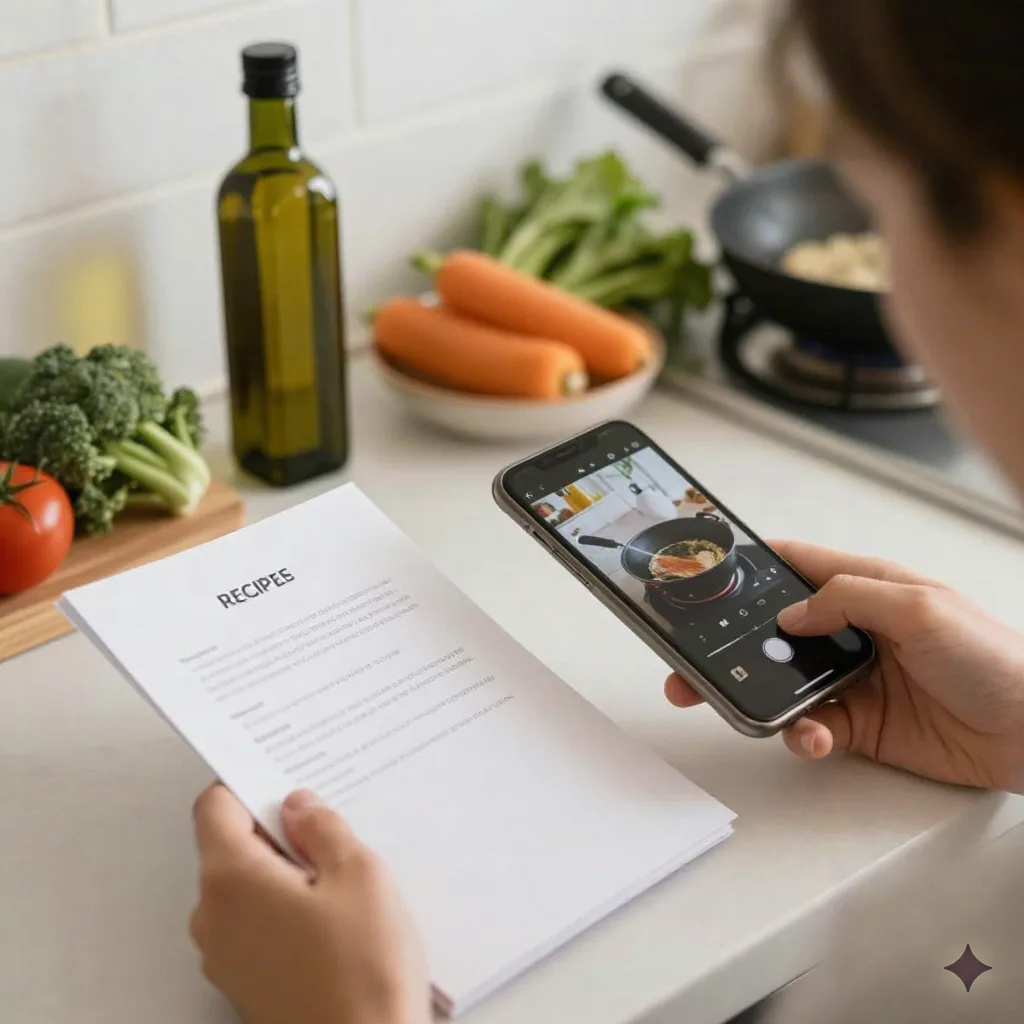
Every AI tool that extracts a recipe from video is, technically speaking, a summarization system with an objectivity constraint baked in. The model reads a transcript, or in some cases the video's caption track, and distills it into structured steps.
The constraint matters because the model is not a cook. It has no way to evaluate whether a technique is correct, whether a quantity makes practical sense, or whether the result will actually taste good. So the system follows what the source says, not what it thinks about the source.
This is why a well-built video-to-recipe tool gives you exactly what was said in the video, even when what was said is incomplete. If the creator says 'cook until it looks right,' that is what gets summarized. The AI does not substitute a temperature or a time: it reports what was there, nothing more.
The result is a summary that is objective but sometimes thin. That is not a failure of the tool. It is a direct reflection of the source material. The thinner the source, the thinner the summary, and that honesty is actually worth something when you are standing in a kitchen trying to follow instructions at 19:30.
Three places where objectivity breaks down in AI recipe summaries
In the 40 recipe extractions I ran across three different tools on the same set of videos, the failures were consistent. They happened in the same three places almost every time.
Oral measurements without subtitles. A creator says 'about a handful of pine nuts' without a caption. The model guesses from context, sometimes outputting 30g, sometimes 50g, sometimes nothing at all. The guess is not in the source. It is an inference. That makes the summary subjective in the worst possible way: invisibly so, with no indication that the number was fabricated.
Units that appear in the visual only. If the chef holds up a measuring cup that clearly shows '1 cup' but never says it out loud, and the caption reads 'add some flour,' the AI reads 'some flour.' The visual information does not exist for a transcript-based model. The resulting summary leaves a gap where there should be a number, and worse, sometimes fills that gap with a statistically plausible quantity from its training data.
Technique language that sounds precise but is not. 'Fry until golden' appears in thousands of recipe summaries. It is objective in the sense that the video used those words, but it is not useful. A real objective summary of a technique should flag when the source is vague, not repeat the vagueness as though it carries the same weight as '3 minutes at 180°C.'

How to write an objective summary of a recipe yourself
If you are reviewing an AI-extracted recipe or verifying what the tool produced, here is a practical checklist to test it against the source:
Opening sentence: Names the dish, the cooking method, and the approximate total time. No adjectives, no quality claims.
Steps section: Each step is one action with a measurable or observable condition. 'Heat olive oil in a pan over medium heat (about 160°C) for 2 minutes' is objective. 'Heat the oil until it shimmers beautifully' is not: 'beautifully' is an opinion, not a condition.
Quantities: Either taken from the source exactly, or flagged as absent. A bracket like [quantity not specified in video] is more honest than a plausible guess. The reader deserves to know what is sourced and what is not.
What to leave out: The creator's comments about their childhood memories of the dish, their preference for a particular brand of tomato, their opinion on whether this technique is easier than another method. Those belong in a personal reading of the video, not in a summary intended to be reusable.
The clearest test: could someone who has never seen the video follow this recipe using only the summary? If yes, the summary is doing its job. If they would still need to watch the video to fill in the gaps, the summary is incomplete rather than objective. Those are different problems with different fixes.
What separates a good AI summary from a mediocre one
The 40 recipe extractions split roughly into two groups, and the split was clear.
The first group produced summaries that matched the video precisely on all measurable elements, quantities, temperatures, times, but flagged nothing when the source was vague. When the video said 'some salt,' the summary said 'some salt.' Technically objective; practically not very useful if you have never cooked this dish before.
The second group introduced small fabrications. Quantities that were not in the video. Steps that were rearranged for what the tool apparently judged to be better clarity. Technique notes drawn from general cooking knowledge rather than from what this specific creator did. These summaries felt more complete and more polished. They were also no longer objective. They were partly the AI's interpretation of what a recipe for this dish should look like, dressed up as a faithful transcription.
The honest version is the first one, even though it is less satisfying to read. A summary that tells you 'the video says to add flour but does not specify how much' is more accurate and more useful over time than one that says '200g of flour' when that number came from a statistical model of similar recipes rather than from the source.
This is a limitation that most AI recipe tools do not disclose clearly. Worth knowing before you trust the quantities on a dish you have not cooked before.
When a subjective layer is actually the right call
There is one situation where adding a subjective layer to a recipe summary makes sense: when you are adapting it for a specific constraint.
If you are scaling from 2 portions to 6, or substituting an ingredient for dietary reasons, or adjusting a technique because your stove runs hotter than the creator's, you are already stepping outside the objective summary. You are making decisions the source did not make. That is entirely valid. It is just a different task.
Call it an adapted recipe rather than an objective summary, and the distinction stays honest. The problem is not adaptation: it is adaptation that is not labelled as such. AI tools that blend the two without flagging it, producing a summary that quietly includes adaptations as though they were in the original, are the ones that cause problems mid-cook. You try to follow the recipe and realize halfway through that the quantities do not match what you see in the video.
Three things to check before using an AI-generated recipe:
Is every quantity traceable to something the creator actually said?
Are any steps flagged as inferences or additions?
Does the method described in the summary match the technique visible in the video?
If the tool cannot answer those questions, treat the output as a starting draft, not a finished recipe.
What a recipe you can cook at 19:30 actually looks like
A good objective summary of a cooking video has one practical measure: you can cook from it without pausing the video seventeen times.
That means every step has a condition you can recognize in your own kitchen, not a description that only makes sense if you watched someone else cook it first. It means every quantity is either stated or clearly flagged as missing. It means the order of steps reflects the actual sequence in the video, not a reorganized version that someone decided would read better.
An objective summary from an AI tool is a starting point. What you do with it, the one or two adjustments only a person standing in a kitchen can make, is yours to add. That combination is what produces a recipe that actually works the first time you try it.